

Japanese matcha is matcha that's actually from Japan — grown, shaded, harvested, and stone-ground there. That sounds obvious, but it's a distinction worth making. A growing share of the "matcha" sold in Australia is Chinese-grown powder labelled with Japanese-sounding branding, and the quality gap between the two is large enough to taste in a single sip.
Japan produced 5,336 tonnes of tencha (the shade-grown leaf that becomes matcha) in 2024, roughly 2.7 times the volume from a decade earlier [1]. Yet tencha still represents only 6% of all Japanese tea grown, which means genuine Japanese matcha is a fraction of the global supply. Most of the matcha on the world market comes from China — roughly 5,000 tonnes in 2025 at much lower price points [2]. That volume difference is what fills supermarket shelves in Australia with cheap powder that technically qualifies as "matcha" but bears little resemblance to what's produced in Kagoshima or Uji.
Key Facts: Japanese Matcha
- Japan is the quality benchmark. Over 90% of the world's genuine ceremonial-grade matcha comes from Japan, because the four-step production process (shade-growing, steam-fixing, deveining into tencha, stone-mill grinding) is Japanese in origin [2].
- Kagoshima is now Japan's #1 matcha region. It overtook Kyoto (Uji) as the top tencha producer in 2020, reaching 1,585 tonnes by 2023 — nearly triple its 2014 output [3].
- Origin determines flavour. Kagoshima matcha is bolder and sweeter (volcanic soil, subtropical climate). Uji matcha is more delicate and umami-forward (mountain terroir, heritage cultivars).
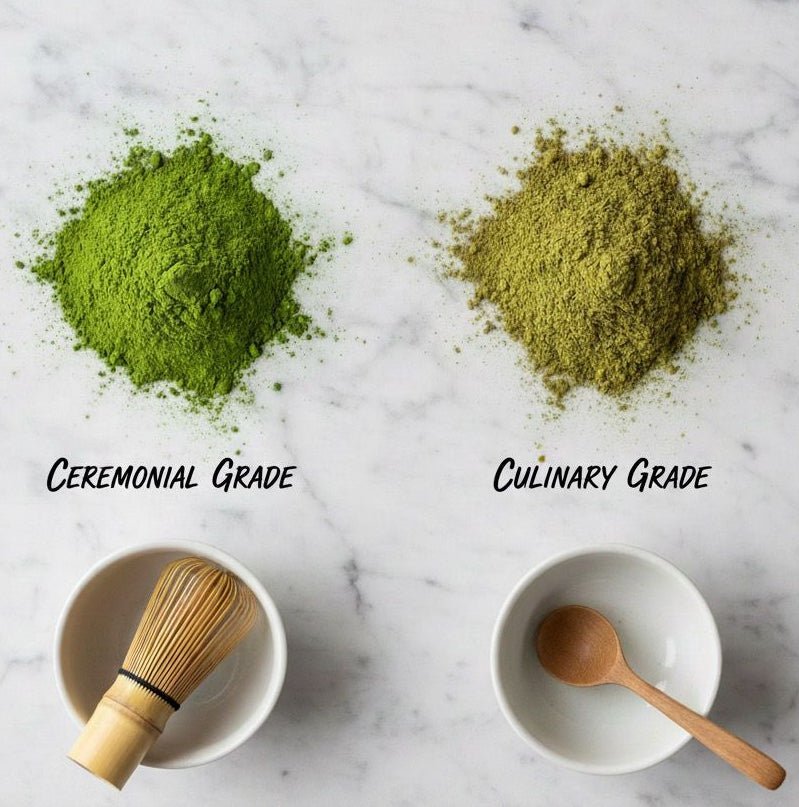
- Colour tells you a lot. Real first-harvest Japanese matcha is vivid jade green. If the powder is yellowish, olive, or dull — it's either low-grade, old, or not Japanese.
- "Japanese-style" doesn't mean Japanese. No regulated definition of "matcha" exists outside Japan. Ask for the prefecture (Kagoshima, Uji, Nishio, Shizuoka) and the farm or co-op.
Why Does Origin Matter So Much With Matcha?
With most teas, you steep the leaf and throw it away. You get maybe 10–20% of whatever's in that leaf. With matcha, you consume the whole thing — ground into a fine powder, whisked into water. Every nutrient, every trace mineral, and every contaminant in that leaf goes directly into you.
That's why origin matters more for matcha than for almost any other tea. The soil the plant grows in, the air around it, the water it absorbs, the regulatory standards the farm operates under — all of it ends up in your cup. Japanese tea farms, particularly in prefectures like Kagoshima and Kyoto, operate under Japan's Agricultural Standards (JAS) system, which mandates testing regimes for pesticide residues and heavy metals that are stricter than what's applied in many competing countries.
This isn't about jingoism. There are good teas grown in China, and there are mediocre teas grown in Japan. But the production infrastructure, the regulatory oversight, and the centuries of cultivar refinement in Japan create a quality floor that's hard to match elsewhere — especially at ceremonial grade.
Japan's Matcha Regions: A Quick Guide
Japan has six major tea-producing prefectures, and three of them account for the bulk of the matcha you'll encounter in Australia. They're not interchangeable. Each region produces matcha with a distinct flavour profile, and the differences come down to soil, climate, altitude, and the cultivars each region favours.
| Region | Location | Soil & Climate | Flavour Profile | Known For |
|---|---|---|---|---|
| Kagoshima | Southern Kyushu | Volcanic (Sakurajima ash), subtropical, 1,600–2,400 mm rainfall | Bold, naturally sweet, full-bodied, deep umami with low bitterness | Now Japan's #1 tencha producer. Strong colour stability, excellent for both drinking and lattes. |
| Uji (Kyoto) | Central Honshu | Mountain river valleys, misty climate, clay-rich soil | Delicate, complex umami, gentle sweetness, refined astringency | The historic matcha capital. Heritage cultivars, tea-ceremony tradition, highest price premiums (30–60% above Kagoshima). |
| Nishio (Aichi) | Central Honshu | Mineral-rich river-delta soil, Pacific-moderated humidity | Smooth, balanced, mildly sweet | Japan's largest single-city matcha producer historically. Consistent quality, broadly appealing flavour. |
| Shizuoka | Central Honshu | Mountain slopes, moderate rainfall, volcanic subsoil | Clean, bright, grassy, mild | Japan's largest overall tea prefecture (historically). More sencha than matcha, but growing tencha production. |
| Yame (Fukuoka) | Northern Kyushu | Mountainous, fog-rich, alluvial soil | Rich, creamy, pronounced sweetness | Smaller volume, high reputation. Multiple Gold Prize wins at Japan's national tea awards. |
Source: MAFF (Japan Ministry of Agriculture, Forestry and Fisheries) [1]; Global Japanese Tea Association [2]
The Kagoshima Story: Why We Source From There
Most people who've heard of Japanese matcha know Uji. It's the name that appears in every tea-ceremony book, and for good reason — Uji's matcha tradition stretches back to the 12th century. For a long time, "Uji matcha" and "good matcha" were treated as synonyms.
But the numbers have shifted. Kagoshima overtook Kyoto as Japan's largest tencha producer in 2020, and the gap has widened since. By 2023, Kagoshima was producing 1,585 tonnes of tencha — nearly triple its 2014 output of 578 tonnes [3]. In 2025, Kagoshima also surpassed Shizuoka as Japan's top first-flush tea producer overall, at approximately 30,000 tonnes [1].
What's driving this? Geography and geology. Kagoshima sits on the southern tip of Kyushu, watched over by Sakurajima — one of Japan's most active volcanoes. The volcanic ash that periodically dusts the region has been enriching the soil for centuries with potassium, calcium, and magnesium [4]. Those minerals feed directly into the tea plants, contributing to Kagoshima matcha's characteristic bold sweetness and vivid green colour.
The subtropical climate helps too. Warmer temperatures and longer daylight hours mean Kagoshima's growing season extends well beyond what colder regions like Uji can manage. The tea plants are vigorous, and the first harvest (ichibancha) arrives earlier — which also means less vulnerability to the spring frosts that devastated Uji's 2024 harvest, cutting its hand-picked tencha production by roughly 40% [5].
Our Premium Ceremonial Matcha comes from a single JAS-certified organic farm in Kagoshima. We chose Kagoshima deliberately — not because it's cheaper than Uji (though it is, because Uji's brand premium runs 30–60% at wholesale [5]), but because the volcanic terroir produces a matcha with the bold sweetness and colour stability that works beautifully both as a traditional bowl and in a matcha latte.
How Japanese Matcha Is Actually Made
The process that turns a tea leaf into matcha powder is longer and more labour-intensive than most people realise. It's also what separates genuine matcha from the green powder you find in budget brands — those products typically skip multiple steps.
1. Shade-growing (20–30 days before harvest)
Tea plants destined for matcha are covered with shade structures that block 85–90% of direct sunlight for the final 20–30 days before harvest. This forces the plant to overproduce chlorophyll (which gives matcha its green) and accumulate L-theanine — the amino acid responsible for the sweet, umami flavour and the calm-focus effect matcha is known for. Without adequate shading, you get a bitter, yellowish powder. Shade duration is the single biggest quality differentiator.
2. Harvesting (first flush matters)
The youngest, most tender leaves from the first spring harvest (ichibancha) make the best matcha. Later harvests produce leaves with more catechins and astringency but less L-theanine and sweetness. Ceremonial grade uses first-harvest leaves. Most culinary grade uses second or third harvest.
3. Steaming and drying
Within hours of picking, the leaves are steamed at roughly 100°C for 10–15 seconds to halt oxidation. This locks in the colour and fresh flavour. The leaves are then dried at 170–200°C. What remains is called 'tencha'—flat, dried leaf flakes with stems and veins still intact.
4. Deveining and ageing
Stems and veins are removed from the tencha (they'd produce a gritty, bitter powder). The cleaned tencha is then aged in cool, dry storage for several months. This step stabilises the flavour, rounding out any remaining harshness. It's often skipped in lower-quality production.
5. Stone-grinding
Finally, the tencha is ground into powder using granite stone mills. This is slow — a single mill produces roughly 30–40 grams per hour. The slow speed prevents heat build-up that would damage the colour and degrade the delicate amino acids. Industrial ball-milling is faster but produces a coarser, duller result.
If a brand can't tell you which of these steps their product went through, that tells you something. For more on preparation technique once the powder reaches your bowl, see our guide to making matcha.
How to Tell if Your Matcha Is Actually Japanese
There's no internationally regulated definition of "matcha". Anyone can grind green tea leaves into powder and call it matcha, regardless of origin, shading duration, or processing method. In Australia, FSANZ doesn't distinguish between Japanese and non-Japanese matcha. So the burden falls on you as a buyer.
Five things to check:
Prefecture, not just country. "Product of Japan" on a label doesn't tell you much — Japan's a big country with varying quality. Look for the specific prefecture: Kagoshima, Uji (Kyoto), Nishio (Aichi), Shizuoka. If the brand can't name it, that's a red flag.
Grade and harvest. 'Ceremonial grade' should mean first-harvest, shade-grown for 20+ days, and stone-ground from tencha. If a product says "ceremonial" but costs $15 for 100 g, the maths doesn't work — stone-grinding alone is too slow and expensive to hit that price point with genuine Japanese leaf.
Colour. Open the tin. Genuine first-harvest Japanese matcha is vivid, saturated green. If it looks olive, yellowish, or brownish, it's either old, insufficiently shaded, or not Japanese. Colour degrades with light and air exposure too, which is why proper packaging (opaque & airtight) matters.
Lab results. Any brand that takes quality seriously should be able to show you third-party test results for heavy metals and pesticide residues. Ours are available on request. If a brand can't produce them, think about why.
Taste. Good Japanese matcha tastes sweet and umami-forward, with a smooth, creamy mouthfeel and minimal bitterness. If your first reaction is a wince, you've probably got low-grade powder. For help getting the most from what you have, see our guide to choosing the right matcha.
Our matcha is sourced from a single JAS-certified organic farm in Kagoshima, Japan. First harvest. Stone-ground. Lab tested. Shipped same-day from Melbourne.
Shop Ceremonial MatchaReferences
- Japan Ministry of Agriculture, Forestry and Fisheries (MAFF). "Japan's Tea Industry in 2025–2026: Official MAFF Data on Matcha, Tencha Production Trends." March 2026 report. matcha-wholesale-japan.com/blogs/news/japans-tea-industry-in-2025-2026
- Global Japanese Tea Association / One With Tea. "Where Is Matcha Grown? A 2026 Global Production Map." onewithtea.com
- Decaf Matcha Japan / Matcha Style. "Who Really Makes the Best Matcha in Japan? (It's Not Just Kyoto)." Tencha production data, 2014–2023. decafmatcha.jp
- Shizuokatea. "Why Volcanic Soil Makes Kagoshima Tea A Supreme Quality Tea." shizuokatea.com
- First Agri B2B. "Japanese Tea Regions Explained: A Buyer's Guide to Origin and Quality." 2026 supply data incl. Uji frost impact. first-agri.jp