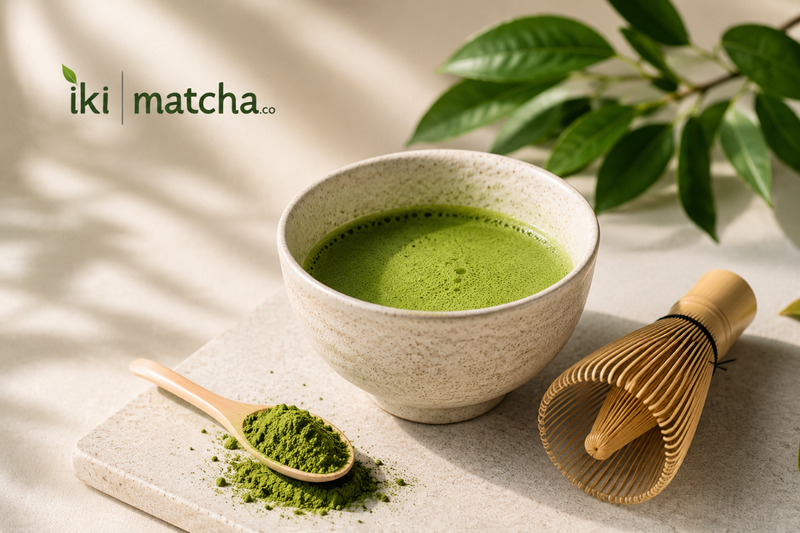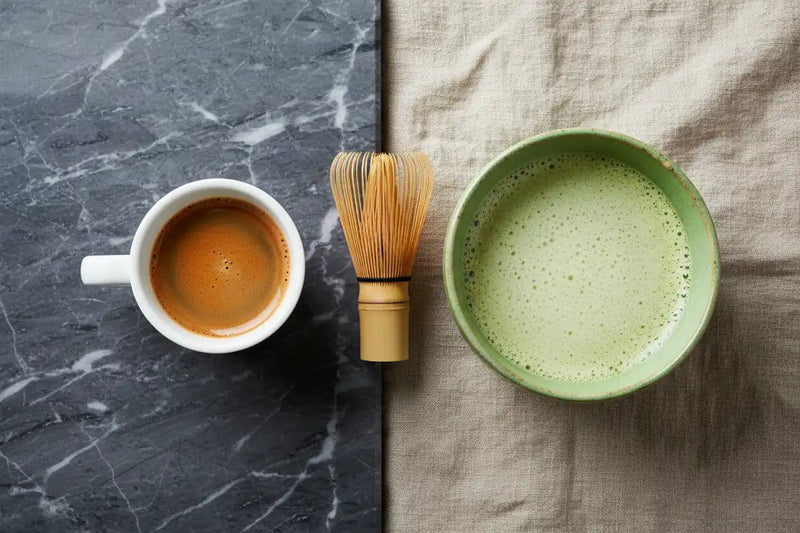


Matcha benefits come from one simple difference: you drink the whole tea leaf. Matcha is shade-grown green tea that's stone-ground into a fine powder and whisked into water, so you swallow everything the leaf contains instead of steeping it and throwing it away. That gives you more antioxidants, more L-theanine and more caffeine per cup than ordinary green tea. The research is real, but it's more modest than social media suggests.
Key facts: matcha benefits at a glance
- A 2 g serve of matcha has about 110 mg of EGCG and 72 mg of caffeine. A cup of brewed sencha has 10-80 mg of EGCG and 28-38 mg of caffeine (Nutrients, 2026).
- Across 31 clinical trials, green tea lowered LDL ("bad") cholesterol by about 0.12 mmol/L on average. That's measurable, but small (Nutrition Journal, 2020).
- In a 12-month trial, 2 g of matcha a day improved emotion recognition in adults aged 60 to 85, with a trend towards better sleep (PLOS One, 2024).
- Matcha as a drink is considered safe for healthy adults. Rare liver problems are linked to concentrated green tea extract capsules, not the tea itself (TGA).
- Grade matters. The top grade in a 2025 lab study held almost three times the L-theanine of food-grade matcha (Plants, 2025).
What makes matcha different from regular green tea?
In 2026, a review in Nutrients by Sławińska and Raczkowska put numbers on the gap: one 2 g serve of matcha delivered roughly 170 mg of catechins and 110 mg of EGCG, while a 235 ml cup of brewed sencha gave 10-80 mg of EGCG. Same plant, Camellia sinensis. The difference is shading before harvest and eating the whole leaf.
Shading the tea plants for the last few weeks before picking pushes the leaves to make more chlorophyll and L-theanine, the amino acid behind matcha's calm kind of alertness. Then stone-grinding means none of it gets left in a teapot. Our guide to what matcha is and how it's made covers the basics, and matcha vs green tea compares the two cup for cup.
| Per serve | Matcha (2 g, whisked) | Sencha (235 ml, brewed) |
|---|---|---|
| Total catechins | ~170 mg | 51-160 mg |
| EGCG (main antioxidant) | ~110 mg | 10-80 mg |
| L-theanine | ~50 mg | Lower (most stays in the leaf) |
| Caffeine | ~72 mg | 28-38 mg |
| Leaf consumed? | Yes, the whole leaf | No, leaves are discarded |
You've probably seen the claim that matcha has "137 times" the antioxidants of green tea. That number came from a 2003 lab comparison against one low-grade tea. Against a decent sencha, the 2026 figures put matcha at roughly 1.5 to 11 times the EGCG. Still a big gap, just not a magic one.
What are the main matcha benefits?
According to the 2026 Nutrients review, the strongest human evidence for matcha covers antioxidant intake, calm focus and small improvements in cholesterol, while gut, gum and metabolic effects rest on smaller, shorter studies. So we've sorted the eight benefits below by how solid the evidence is, not by how exciting they sound.
Matcha benefits by strength of evidence
Based on human studies published 2020-2026. Green = consistent human trials. Light green = some trials, small effects. Amber = early or small studies.
- StrongMore antioxidants per cupAbout 110 mg EGCG per 2 g serve
- StrongCalm, steady focusL-theanine plus caffeine, fewer jitters
- ModerateLower LDL cholesterolAbout 0.12 mmol/L across 31 trials
- ModerateSocial cognition with age12-month trial, 2 g a day
- EarlyBlood sugarSmall drop in fasting glucose
- EarlyGut bacteriaShifts seen after 2 weeks
- EarlyGum healthMostly mouthwash studies
- EarlySkin and metabolismPromising, not proven
1. A concentrated source of antioxidants
Matcha's catechins, EGCG above all, neutralise free radicals in lab studies, and one whisked serve holds more of them than most brewed green teas. What that does inside a healthy body over years is harder to pin down. Antioxidant intake is a solid reason to drink matcha. "Detox" isn't, and we'd be wary of anyone who says otherwise.
2. Calm, steady focus instead of a caffeine spike
This is the benefit most people notice first. L-theanine softens the edge of caffeine, so the lift feels smoother than coffee and tends to fade more gently. We've written a full piece on matcha for focus and calm energy, plus a look at whether matcha lowers cortisol and how it fits into stress during perimenopause. Wondering how it stacks up against your flat white? See matcha vs coffee.
3. A small, real drop in LDL cholesterol
In 2020, Xu and colleagues pooled 31 randomised trials with 3,321 people in Nutrition Journal. Green tea lowered LDL cholesterol by 4.55 mg/dL (about 0.12 mmol/L) and total cholesterol by a similar amount. HDL, the "good" cholesterol, didn't change. Useful alongside diet and exercise, but it won't replace medication.
Blood pressure is shakier. A 2026 Frontiers in Nutrition analysis of 20 studies covering 319,565 people linked regular tea drinking with modestly lower odds of hypertension, yet green tea on its own showed no significant link.
4. A slight nudge to blood sugar
The 2026 Nutrients review cites a meta-analysis of 27 trials where green tea lowered fasting glucose by 1.44 mg/dL (under 0.1 mmol/L), with no effect on insulin or HbA1c. That's a nudge, not a treatment. If you manage diabetes, talk to your GP before relying on any food for it.
5. Early signs of friendlier gut bacteria
Because you eat the whole leaf, matcha brings fibre and polyphenols that reach your gut bacteria. A two-week human study in the same review found more Coprococcus, a bacterium linked to gut health, and less Fusobacterium, which is associated with inflammation. Two weeks is short, though.
6. Healthier gums (mostly from mouthwash studies)
Here's one you won't find on most matcha pages. In 2024, Nakao and colleagues reported in Microbiology Spectrum that matcha stopped Porphyromonas gingivalis, a major gum disease bacterium, from growing in the lab. In 45 adults with gum disease, a matcha mouthwash lowered its levels in saliva. That was rinsing, not drinking, but the 2026 review also notes less gum bleeding after 30 days of drinking matcha.
7. Sharper social cognition in older adults (and maybe better sleep)
In a 2024 PLOS One trial, Uchida and colleagues gave 99 adults aged 60 to 85 with mild cognitive decline either 2 g of matcha or a placebo every day for 12 months. The matcha group got significantly better at recognising emotions in faces. Their main cognitive test scores didn't change. Sleep quality trended better too, though not by enough to be conclusive. A caffeinated drink that might help sleep? Possibly, as long as you have it early. Our guide to the best time to drink matcha explains why.
8. Skin and metabolism: interesting, not settled
In a small 2026 trial in Physiological Reports, 3 g of matcha raised brown fat activity in 30 young women, but only in those who started with low activity. Weight effects overall are modest, which we cover honestly in does matcha help with weight loss? For skin, read what the science says about matcha for skin and hair. There are also guides by life stage: matcha for women's health and matcha benefits for men.
How much matcha do you need for the benefits?
Most human trials used about 2 g a day, which is one level teaspoon or a single cup. The 12-month PLOS One study used exactly that. More isn't clearly better, and each 2 g serve adds roughly 72 mg of caffeine, so three cups lands you somewhere near 215 mg.
That matters because Food Standards Australia New Zealand notes that around 240 mg a day, about three cups of instant coffee, is where adults may start to feel more anxious. For a proper breakdown, see how much matcha you should drink in a day and how much caffeine is in matcha.
Who should be careful with matcha?
The US National Institutes of Health says no safety concerns have been reported for green tea drunk as a beverage by adults. Australia's TGA reached a similar view in 2018: of 20 liver-related reports it received, all but one involved concentrated extracts, not the tea. A few groups should still take care.
- If you're pregnant or breastfeeding, caffeine adds up fast. Read is matcha safe during pregnancy? before your next latte.
- Kids have lower caffeine limits than adults. See should children drink matcha?
- On regular medication? The NIH notes green tea can make nadolol (a beta-blocker) and atorvastatin (a cholesterol drug) work less well, so ask your pharmacist.
- Green tea extract capsules aren't the same as the drink. The liver warnings apply to the pills.
Does the grade of matcha change the benefits?
Yes, measurably. In 2025, Toniolo and colleagues compared matcha grades in the journal Plants. The top grade held about 978 mg of L-theanine per 100 g, while food-grade matcha held 352 mg. EGCG and caffeine followed the same pattern, which is why the first flush is worth paying for when you drink it straight.
Our Ceremonial First Harvest matcha is picked from the spring first flush on a single farm in Kagoshima, stone-ground and lab-tested in Australia. For baking and smoothies, organic culinary matcha makes more sense, and if you mostly drink lattes, our ceremonial latte blend is made for milk. Not sure which one suits you? Our guide on which matcha to buy walks you through it.
Taste the difference first-harvest matcha makes
Single-farm Kagoshima matcha, shade-grown, stone-ground and lab-tested in Australia. Under $1 a cup.
Buy matcha powderThe honest bottom line on matcha benefits
Matcha won't cure anything. What it does well is hand you a lot of antioxidants and a calm, useful lift in one small cup, with modest extras for cholesterol and possibly your gut, gums and sleep. One or two cups a day of good matcha, made properly, is where the research sits. If you've never whisked one, start with our step-by-step guide to making matcha or grab the matcha starter kit.
Sources
All sources retrieved 23 September 2026.
- Sławińska P, Raczkowska E. Matcha as a Source of Bioactive Compounds: A Review of Health-Promoting Properties and Potential Applications. Nutrients, 2026. https://pmc.ncbi.nlm.nih.gov/articles/PMC13209849/
- Jiang R, Chen J, Lin H, Wang Q, Hu Y. The association between tea consumption and hypertension: a systematic review and meta-analysis. Frontiers in Nutrition, August 2026. https://www.frontiersin.org/journals/nutrition/articles/10.3389/fnut.2026.1883708/full
- Taniguchi et al. Single intake of matcha increases brown adipose tissue activity in young women with low thermogenesis. Physiological Reports, 2026. https://pmc.ncbi.nlm.nih.gov/articles/PMC13135111/
- Food Standards Australia New Zealand. Caffeine. Updated 26 November 2025. https://www.foodstandards.gov.au/consumer/prevention-of-foodborne-illness/caffeine
- Toniolo et al. A Comparative Multianalytical Approach to the Characterization of Different Grades of Matcha Tea. Plants, 2025. https://pmc.ncbi.nlm.nih.gov/articles/PMC12157965/
- Uchida K et al. Effect of matcha green tea on cognitive functions and sleep quality in older adults with cognitive decline: a randomized controlled study over 12 months. PLOS One, 2024. https://pmc.ncbi.nlm.nih.gov/articles/PMC11364242/
- Nakao R et al. Multimodal inhibitory effect of matcha on Porphyromonas gingivalis. Microbiology Spectrum, 2024. https://pmc.ncbi.nlm.nih.gov/articles/PMC11218439/
- Xu R, Yang K, Li S, Dai M, Chen G. Effect of green tea consumption on blood lipids: a systematic review and meta-analysis of randomized controlled trials. Nutrition Journal, 2020. https://pmc.ncbi.nlm.nih.gov/articles/PMC7240975/
- National Center for Complementary and Integrative Health (US National Institutes of Health). Green Tea: Usefulness and Safety. https://www.nccih.nih.gov/health/green-tea
- Therapeutic Goods Administration. Camellia sinensis (green tea) extract: safety advisory, potential risk of harm to the liver. 5 June 2018. https://www.tga.gov.au/safety/safety-monitoring-and-information/safety-alerts/camellia-sinensis-green-tea-extract