Matcha and pregnancy is one of those topics where you'll find confident answers in both directions, "totally fine!" from wellness influencers and "avoid completely!" from overly cautious forums. The reality sits somewhere more useful than either extreme.
Matcha is a concentrated form of green tea where you consume the whole ground leaf, not just a steeped infusion. That means more antioxidants per serve, but also more caffeine and more exposure to anything else in the leaf — including trace heavy metals. For pregnant women, the practical question isn't whether matcha is "safe" or "unsafe" in absolute terms. It's how much, how often, what grade, and what else you're consuming alongside it.
Key Facts: Matcha During Pregnancy
- Caffeine per serve: 1g of matcha powder contains roughly 30–70 mg of caffeine — about half a standard espresso.
- Daily limit: ACOG recommends pregnant women stay under 200 mg total caffeine per day from all sources combined [1].
- Folate interaction: EGCG (a catechin in matcha) can reduce folic acid absorption by up to 39% when consumed at the same time [2].
- Simple fix: Take your prenatal vitamin at a different time from your matcha — at least 2 hours apart.
- Heavy metals: Because you ingest the whole leaf, quality and origin matter more than with steeped tea. Choose lab-tested, Japanese-origin matcha [3].
- Bottom line: One small serve of high-quality matcha per day (1g powder) is generally within safe guidelines. Check with your GP or midwife.
How Much Caffeine Is in Matcha, and How Does It Compare?
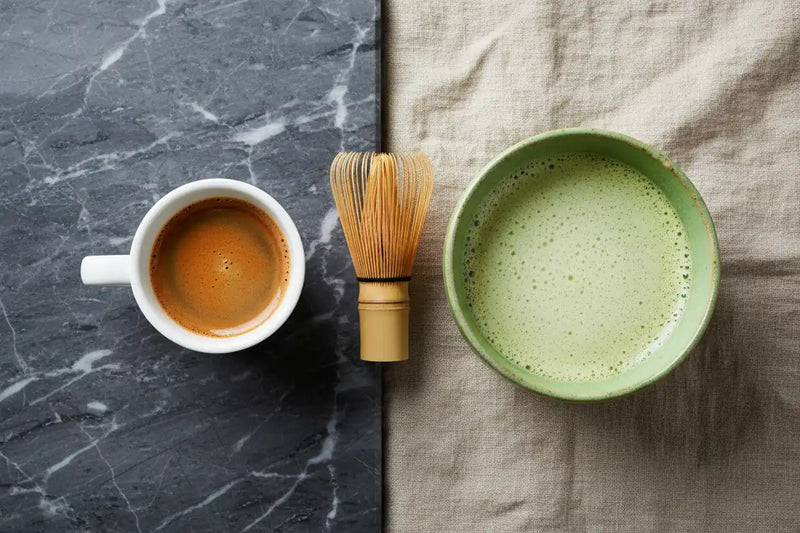
A standard serve of matcha uses about 1–2 grams of powder whisked into water. That gives you roughly 30–70 mg of caffeine — the exact number depends on the grade, the farm, and how much powder you use. Compare that to a flat white from your local café, which typically runs 120–170 mg for a double shot.
Here's how matcha stacks up against common caffeine sources an expecting mum might encounter during the day:
| Beverage | Typical Serve | Caffeine (mg) | Serves to Hit 200 mg |
|---|---|---|---|
| Matcha (1g powder) | 70 ml bowl | 30–70 | ~3–6 |
| Matcha latte (2g powder) | 250 ml cup | 60–140 | ~1.5–3 |
| Flat white (double shot) | 180 ml | 120–170 | ~1.2 |
| Instant coffee | 250 ml mug | 60–80 | ~2.5–3 |
| Black tea (steeped) | 250 ml cup | 40–50 | ~4–5 |
| Green tea (steeped) | 250 ml cup | 25–40 | ~5–8 |
| Coca-Cola | 375 ml can | 36 | ~5.5 |
| Dark chocolate | 30g square | 20–25 | ~8–10 |
Sources: ACOG [1]; EFSA [4]; FSANZ [5]
One thing the table makes clear: a single small matcha (1g of powder) is a low-caffeine choice compared to a coffee. But a large café-made matcha latte — the kind that uses 2–3 scoops — can creep towards the same caffeine load as a flat white. If you're ordering out, it's worth asking how much powder goes in.
And remember, the 200 mg limit covers everything. That includes the chocolate you had after lunch and the black tea at 3 pm. Most people undercount by about 20%.
Why Pregnancy Changes How Your Body Handles Caffeine
Something most articles skip over: pregnancy actually changes your caffeine metabolism. In a non-pregnant adult, the half-life of caffeine is roughly 4–5 hours. By the third trimester, that extends to as long as 15 hours [6]. Your morning matcha is still circulating at bedtime.
Caffeine also crosses the placental barrier freely. Your baby's liver can't metabolise it efficiently, so what takes you 5 hours to clear might take a developing foetus much longer [6]. That's the main reason ACOG, the WHO, and Food Standards Australia New Zealand (FSANZ) all recommend keeping intake moderate — not because one cup is dangerous, but because the drug accumulates differently when you're pregnant.
The practical takeaway: if you're going to have matcha, earlier in the day is better, and a smaller serve gives your body more time to process it before the caffeine stacks with anything else you consume later.
The Folate Question: Can Matcha Interfere With Folic Acid?
This is the part that rarely gets enough attention. Caffeine gets all the headlines, but there's a second interaction that arguably matters more in the first trimester.
EGCG — the same catechin that gives matcha its antioxidant reputation — can interfere with folic acid absorption. A 2008 pharmacokinetic study in healthy volunteers found that green tea reduced the peak blood concentration of folic acid by approximately 39% when they were consumed together [2]. EGCG does this in two ways: it inhibits the intestinal absorption of folate, and it blocks the enzyme (dihydrofolate reductase) that converts folic acid into its active form [7].
Folate is critical for neural tube development, particularly in the first 4–6 weeks of pregnancy — a window where many women don't yet know they're pregnant. A Chinese epidemiological study found that women who drank tea daily during the periconceptional period had a threefold increased risk of neural tube defects compared to non-tea-drinkers [8].
Before you panic: these studies looked at high tea consumption (multiple cups daily), not a single moderate matcha serve. At typical doses of 1–2g per day, the interaction is smaller — especially if you're already taking a prenatal vitamin containing methylfolate.
The fix is simple timing. Don't drink matcha at the same time as your prenatal supplement. Leave at least 2 hours between them. Take your prenatal vitamin with a meal that doesn't include tea, and have your matcha separately. This largely sidesteps the absorption issue.
Does Matcha Offer Any Benefits During Pregnancy?
Matcha isn't just caffeine in a green package. It contains a concentrated dose of compounds that have genuine research behind them — though the honest caveat is that most of this research was conducted outside of pregnancy-specific settings.
Antioxidants (EGCG and catechins)
Matcha contains significantly more catechins per gram than steeped green tea because you consume the entire leaf. EGCG in particular has been studied for its role in reducing oxidative stress, which may support immune function [9]. During pregnancy, your immune system is naturally modulated, so antioxidant-rich foods have a plausible role — though direct evidence for matcha improving pregnancy outcomes specifically is limited.
L-theanine and calmer energy
This amino acid is one of the genuinely interesting things about matcha. L-theanine promotes alpha brain wave activity — the relaxed-focus state — and appears to soften the jittery edge of caffeine [10]. If you're switching away from coffee because it makes you anxious, matcha's caffeine-plus-L-theanine combination gives a qualitatively different kind of alertness. Several women I've spoken to describe it as "awake without wired."
However, human studies on L-theanine specifically during pregnancy are very sparse. The benefits are extrapolated from general-population research, and your doctor may have a more cautious view.
Micronutrients
Matcha contains small amounts of vitamins A, C, and E, along with potassium and traces of iron and calcium. These aren't game-changing quantities — your prenatal vitamin covers your needs — but they're a small bonus compared to beverages with no nutritional value at all.
The Heavy Metals Question: Why Quality Matters More During Pregnancy
Here's where I want to be direct, because this part genuinely matters and too many matcha brands gloss over it.
Tea plants absorb metals from the soil. With steeped tea, you discard the leaves and only drink the infusion — so your exposure is limited. With matcha, you consume the whole leaf ground into powder. Any lead, cadmium, or arsenic in that leaf goes directly into you.
Independent testing by Lead Safe Mama (a US-based consumer safety group) has found detectable lead in multiple commercially-available matcha brands, including several marketed as "organic" and "pure" [3]. A 2023 Consumer Reports investigation of 29 green tea products reported similar findings — lead levels varied enormously between brands, with sourcing origin as the strongest predictor [11].
Japanese-origin matcha from regulated farms (particularly Kagoshima, Uji, and Nishio) consistently tests lower for heavy metals than products sourced from regions with heavier industrialisation [3]. Organic certification alone isn't a guarantee of low heavy-metal content — it addresses pesticides, not soil contamination. What you really want is third-party lab testing with published results.
Our ceremonial matcha is sourced from a single JAS-certified organic farm in Kagoshima, Japan, and is lab tested for heavy metals. During pregnancy, that's exactly the kind of sourcing transparency worth paying attention to.
First Trimester, Second Trimester, Third Trimester: Does It Change?
The risks aren't uniform across all nine months. Here's how the considerations shift:
First trimester (weeks 1–12): The highest-stakes period. Neural tube formation happens in weeks 3–6, making folate availability critical. Miscarriage risk is also highest in early pregnancy, and some studies associate higher caffeine intake with increased risk during this window [1]. If you're going to be conservative, this is the trimester to be most careful — keep matcha to one small serve, well separated from your prenatal vitamin.
Second trimester (weeks 13–26): Neural tube closure is complete. The folate-absorption concern diminishes somewhat (though folate remains important throughout). Caffeine metabolism starts slowing. One serve per day is generally considered low-risk.
Third trimester (weeks 27–40): Caffeine half-life can extend to ~15 hours. The drug accumulates more, so even moderate intake stays in your system longer. Keep it to mornings, stick to 1g of powder, and track your total daily caffeine from all sources.
None of this means you need to give up matcha entirely at any point. It means the maths of how much and when shifts as the pregnancy progresses.
Practical Tips for Drinking Matcha Safely During Pregnancy
If you've read this far and your takeaway is "okay, I can probably still have matcha but I need to be sensible about it" — that's about right. Here's the practical version:
Use 1g of powder per serve. That's roughly half a flat teaspoon, or one chashaku scoop. It gives you approximately 30–70 mg of caffeine, leaving plenty of room under the 200 mg daily ceiling.
Track your total caffeine. If you're having a matcha in the morning and a piece of dark chocolate after lunch, you're probably fine. If you're having a matcha, a chai, and a Coke, you're likely over. It's all additive.
Separate matcha from your prenatal supplement by at least 2 hours. The EGCG-folate interaction is real but manageable with timing. Take your prenatal with dinner, have your matcha mid-morning.
Choose ceremonial grade matcha from a known Japanese origin with published lab testing. During pregnancy, this isn't marketing talk — it's a genuine quality control question about what's in the leaf you're consuming whole.
Drink it after eating. Matcha on an empty stomach can cause nausea in early pregnancy, and food in your stomach buffers the caffeine absorption rate.
Skip matcha supplements and extracts entirely. Concentrated green tea extract capsules deliver far higher doses of EGCG than brewed matcha, and have been linked to liver concerns even outside of pregnancy [12]. The whole-food drink form is the safe form.
What About Matcha Lattes?
Matcha lattes are fine during pregnancy — the milk doesn't change the safety profile of the matcha. The thing to watch is how much powder goes in.
A homemade matcha latte where you control the scoop (1g of powder, whisked with a little hot water, then topped with heated oat or dairy milk) is easy to keep within limits. Our Ceremonial Matcha Latte Blend is designed exactly for this — it's a pure ceremonial-grade matcha that holds its flavour in milk without needing extra powder to compensate.
Café-bought matcha lattes are harder to gauge. Some cafés use 2–3g of powder per drink, which can push the caffeine up to 80–140 mg in a single serve. That's not unsafe on its own, but it doesn't leave much room for anything else. If you're ordering out, ask how many grams (or scoops) they use.
Matcha During Breastfeeding
The caffeine guideline stays roughly the same after birth: most guidelines suggest keeping daily intake under 200–300 mg while breastfeeding [13]. Caffeine does pass into breast milk, and some babies are more sensitive to it than others — restlessness, poor sleep, and fussiness can be signs.
If you notice these symptoms, try reducing your matcha intake for 48–72 hours and see whether they resolve. Drinking your matcha right after a feed (rather than right before) minimises the amount of caffeine in the next feed.
If you're choosing matcha during pregnancy, quality and sourcing are the things that matter most. Our ceremonial matcha is sourced from a single JAS-certified organic farm in Kagoshima, Japan — first harvest, stone-ground, and lab tested.
Shop Ceremonial MatchaReferences
- American College of Obstetricians and Gynecologists (ACOG). "Moderate Caffeine Consumption During Pregnancy." Committee Opinion No. 462. acog.org
- Alemdaroglu NC, et al. "Influence of green and black tea on folic acid pharmacokinetics in healthy volunteers: potential risk of diminished folic acid bioavailability." Biopharmaceutics & Drug Disposition, 2008;29(6):335–348. ResearchGate
- Lead Safe Mama (Tamara Rubin). "Chart Comparing the Toxicant Profiles of Popular Matcha Products Tested by an Independent, Third-Party Lab in 2024–2025." tamararubin.com/matcha-chart
- European Food Safety Authority (EFSA). "Scientific Opinion on the safety of caffeine." EFSA Journal, 2015;13(5):4102. efsa.europa.eu
- Food Standards Australia New Zealand (FSANZ). "Caffeine." foodstandards.gov.au/consumer/generalissues/caffeine
- Modzelewska D, et al. "Pregnancy and Caffeine Metabolism: Updated Insights and Implications for Maternal–Fetal Health." Nutrients, 2025. PMC12526311
- EGCG-folate interaction: ScienceDirect, "EGCG induces degradation of active folate in serum via H2O2 generation." Food Bioscience, 2024. sciencedirect.com
- Ye R, et al. "Tea drinking as a risk factor for neural tube defects in Northern China." Epidemiology, 2011;22(4):491–496. PubMed
- Kochman J, et al. "Health Benefits and Chemical Composition of Matcha Green Tea: A Review." Molecules, 2021;26(1):85. PMC7796401
- Dietz C, Dekker M. "Effect of Green Tea Phytochemicals on Mood and Cognition." Current Pharmaceutical Design, 2017;23(19):2876–2905. PMC6836118
- Consumer Reports. "Arsenic and Lead Are in Your Fruit Juice: What You Need to Know." Updated testing including tea products, 2023. consumerreports.org
- LiverTox, National Library of Medicine. "Green Tea." ncbi.nlm.nih.gov/books/NBK547925
- The Royal Women's Hospital, Melbourne. "Caffeine and pregnancy." thewomens.org.au