

Here's what's actually happening, why it's pushing prices up in Australia, and how to make sure the matcha you buy is the real thing at a time when cheap powder is quietly being relabelled to cash in.
Key Facts: The 2026 Matcha Shortage
- It's a genuine supply shortage, not hype. The Global Japanese Tea Association has described it as the first matcha shortage in history.[3]
- The squeeze is in tencha, the shade-grown leaf used for ceremonial matcha, not green tea overall. Ceremonial grade is hit hardest.[3]
- Prices have jumped sharply. Wholesale matcha sits roughly 40–60% above pre-shortage levels, and top-grade ceremonial rose around 75% year-on-year on the 2025 crop.[4]
- Australia feels it at the counter. A Sydney matcha latte has climbed from about $5.50 in 2020 to roughly $8.50 in 2025, and AU imports of Japanese green tea rose nearly 20% in a year.[1]
- Fake matcha is the buyer's real risk. With supply tight, powdered sencha is being sold as "matcha," and a genuine ceremonial tin simply can't be produced at rock-bottom prices.[2][4]
Is There Really a Matcha Shortage in 2026?
Yes. This is a genuine supply constraint, and it's showing up in the most concrete way possible: through early 2026, tea shops in Japan were still limiting customers to one tin each, and cafes across major cities have faced restocking gaps.[2][3] The Global Japanese Tea Association has gone as far as calling it the first matcha shortage in history.[3]
One important clarification: this is a shortage of matcha specifically, not of green tea in general. The pinch is in tencha, the shade-grown leaf that gets stone-ground into matcha, and above all in genuine first-harvest, ceremonial-grade tencha. Japan's wider green tea exports have actually risen over the same period. So the shelves emptying are the good matcha shelves.[3]
Why Is Matcha Sold Out and So Expensive?
The short version: global demand grew far faster than Japan can expand production, and matcha is uniquely slow to scale. A few structural reasons stack up.
Matcha is harvested mainly once a year, each spring, so supply is essentially fixed for months at a time. When demand spikes, there's no second tap to turn on. Tencha is only a small share of total Japanese tea output, and converting an ordinary tea field to tencha needs shading equipment, different pruning and new handling, then about five years for new plants to reach full production. On top of that, Japan's tea-farming workforce is ageing fast: the country lost tens of thousands of tea farmers to retirement between 2000 and 2020, with the next generation not stepping in at the same rate.[3][4] Record heat in 2024 also cut yields in core regions like Kyoto.[3]
Then there's the mill itself. Genuine matcha is ground slowly on granite stone mills that produce only about 40 grams an hour, a fixed ceiling that can't scale up to meet a demand surge. When scarce leaf meets intense demand at every step, prices climb the whole way down the chain. On the 2025 crop, top-grade ceremonial wholesale rose roughly 75% year-on-year, mid-grade around 50%, and culinary around 30%.[4]
| Grade | Rough wholesale rise (2025 crop, year-on-year) | Why |
|---|---|---|
| Ceremonial (first-harvest) | ~75% | Most demand, tightest supply, luxury pull |
| Premium / latte | ~50% | Cafe and RTD-drink demand competing for leaf |
| Culinary | ~30% | Later-harvest leaf, more production flexibility |
Source: trade reporting on the 2025 Japanese crop.[4]
What It Means for Australian Buyers
Australia sits at the far end of this chain, which means we feel the price pressure and the supply gaps, just a little later than Japan. Matcha has become a genuine cafe staple here, and the cost of a cup has climbed steadily. In Sydney, the average matcha latte has gone from about $5.50 in 2020 to roughly $8.50 in 2025, with Melbourne, Brisbane, Perth and Adelaide all following the same upward line. Australian imports of Japanese green tea rose nearly 20% year-on-year in 2024, which tells you demand here isn't slowing.[1]
What this means in practice: expect higher retail prices, some tins selling out and slower restocks, and smaller or more expensive cafe serves. It also means the make-it-at-home maths has never looked better. At $8.50 a cup, a tin you whisk yourself pays for itself quickly, which is part of why home matcha has grown right through the shortage.
The Hidden Risk: Fake and Relabelled "Matcha"
This is the part that matters most for your wallet and your cup. When genuine matcha gets scarce and expensive, the incentive to cut corners rises with it. Reporting out of Japan has already flagged cases of powdered sencha being sold as "matcha," and the economics are simple: at current leaf prices, a genuine first-harvest ceremonial tin can't be produced at rock-bottom cost. A "ceremonial" tin priced like a supermarket special is a warning sign, not a bargain.[2][4]
So the shortage doubles as an authenticity test. The brands worth buying from are the ones that can tell you exactly what's in the tin and where it came from. For the full checklist, our guide to Japanese matcha in Australia goes deeper, but here's the short version for right now.
How to spot genuine ceremonial matcha in 2026
Named prefecture, not just "Japan." Look for Kagoshima, Uji, Nishio or Shizuoka. A brand that can't name the region is a red flag.
First harvest and stone-ground. Genuine ceremonial is spring first-flush, ground slowly on stone. That process costs money, which is why the price floor is real.
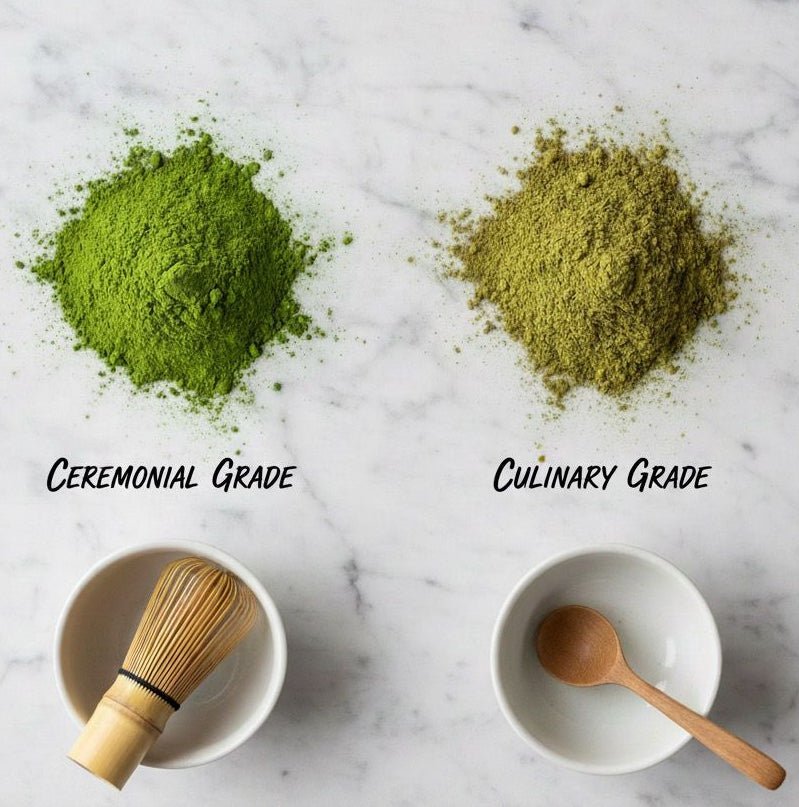
Vivid colour. Real first-harvest matcha is a bright, saturated jade green. Olive, yellow or brown means old, low-grade, or not genuine.
Lab results on request. A serious brand can show third-party testing for heavy metals and pesticides. If they can't, ask why.
A believable price. If a "ceremonial" tin is priced near culinary levels during a shortage, the maths doesn't add up. For how the grades and prices compare, see our ceremonial vs culinary guide.
Where We Sit: Kagoshima and the Shortage
There's a reason we source from Kagoshima, and the shortage makes it clearer. While Uji, the historic matcha capital, is the most supply-constrained region, Kagoshima in the south has a longer growing season and more production flexibility, and it has been expanding tencha output faster than anywhere else in Japan. That doesn't make Kagoshima immune to the price rises, nobody is, but it does mean a steadier supply of genuine, first-harvest ceremonial leaf.
Our matcha comes from a single JAS-certified organic farm in Kagoshima. A direct, single-farm relationship is exactly what gives smaller brands consistent access to real leaf in a market where allocations are tight and large processors are bidding aggressively for supply.[4] We'd rather hold the line on quality and be honest about pricing than chase a cheaper tin that isn't what it claims to be.
Single-origin Kagoshima ceremonial matcha, first harvest and stone-ground, lab tested, and shipped same-day from Melbourne. Real leaf, honest pricing, through the shortage and beyond.
Shop Ceremonial MatchaReferences
- Torrens University Australia. "Why is there a shortage of matcha and will prices rise?" (Australian cafe prices 2020–2025, imports, market growth.) torrens.edu.au
- The Japan Times, reported via Yahoo News. "Global Matcha Shortage Threatens to Spike Prices of a Morning Staple." (Purchase limits, once-a-year harvest, market size.) yahoo.com/new
- One With Tea. "2026 Matcha Industry Outlook" & "The 2026 Matcha Shortage Explained." (Wholesale rises by grade via Fortune reporting, aging workforce, allocation pressure, Kagoshima.) onewithtea.com